Export Compliance

End-to-End Export Control Compliance

GingerControl's export control suite covers the full compliance workflow, from ITAR jurisdiction screening and ECCN classification to end-use analysis, export license determination, and license exception eligibility. Our AI reads your product's technical specifications, checks every control parameter in each ECCN entry, and asks clarifying questions when the product description alone is not enough to determine whether a control threshold is triggered. Every step produces a detailed research report with complete reasoning chains.

Full Export Control Workflow

Five integrated tools that cover the entire export compliance lifecycle. Each tool produces a detailed research report with full reasoning, ready for your compliance team to review.

01

ITAR Screening

Determine whether your product falls under ITAR jurisdiction by screening against all 21 categories of the U.S. Munitions List (USML). The AI analyzes your product's technical specifications against each USML category's control parameters and produces a detailed jurisdiction determination report.

02

ECCN Classification

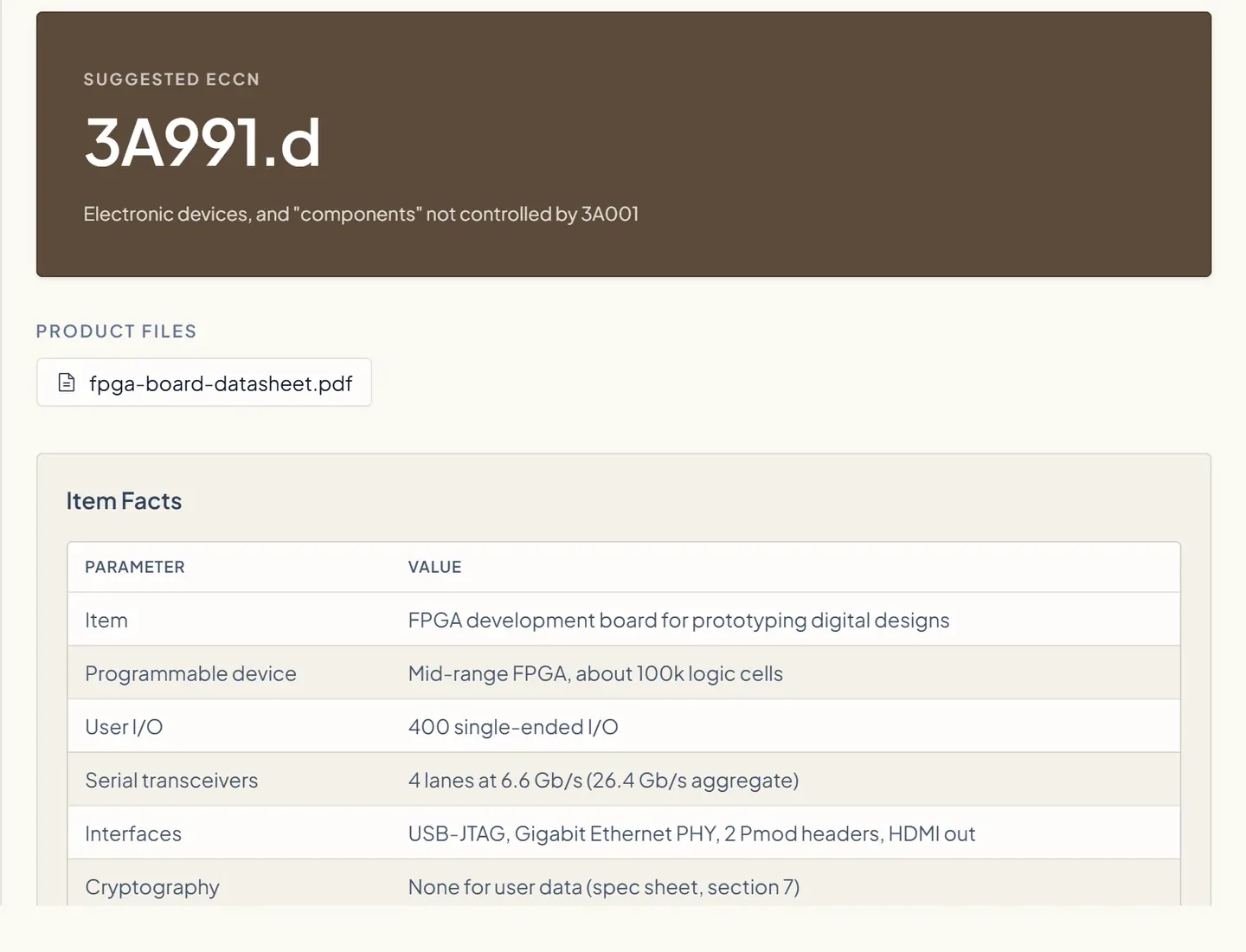
Classify your product against all 10 categories of the Commerce Control List (CCL). The AI checks every control parameter within each candidate ECCN, determines whether your product triggers specific control thresholds, and applies the 'specially designed' analysis under EAR Part 772.

03

End Use / End User Screening

Screen transaction parties against OFAC SDN, BIS Entity List, Denied Persons List, Unverified List, and other consolidated screening lists. Cross-reference end-use statements against prohibited end-use activities.

04

Export License Determination

Cross-reference your product's ECCN with the destination country on the Commerce Country Chart to determine whether a BIS export license is required. Factor in reasons for control, embargo status, and sanctions programs.

05

License Exception Screening

Evaluate eligibility for license exceptions including TMP, STA, ENC, GOV, TSR, and APR. Verify that all conditions and restrictions for each exception are met before recommending an applicable exception.

How It Works

01

Submit Your Product Data

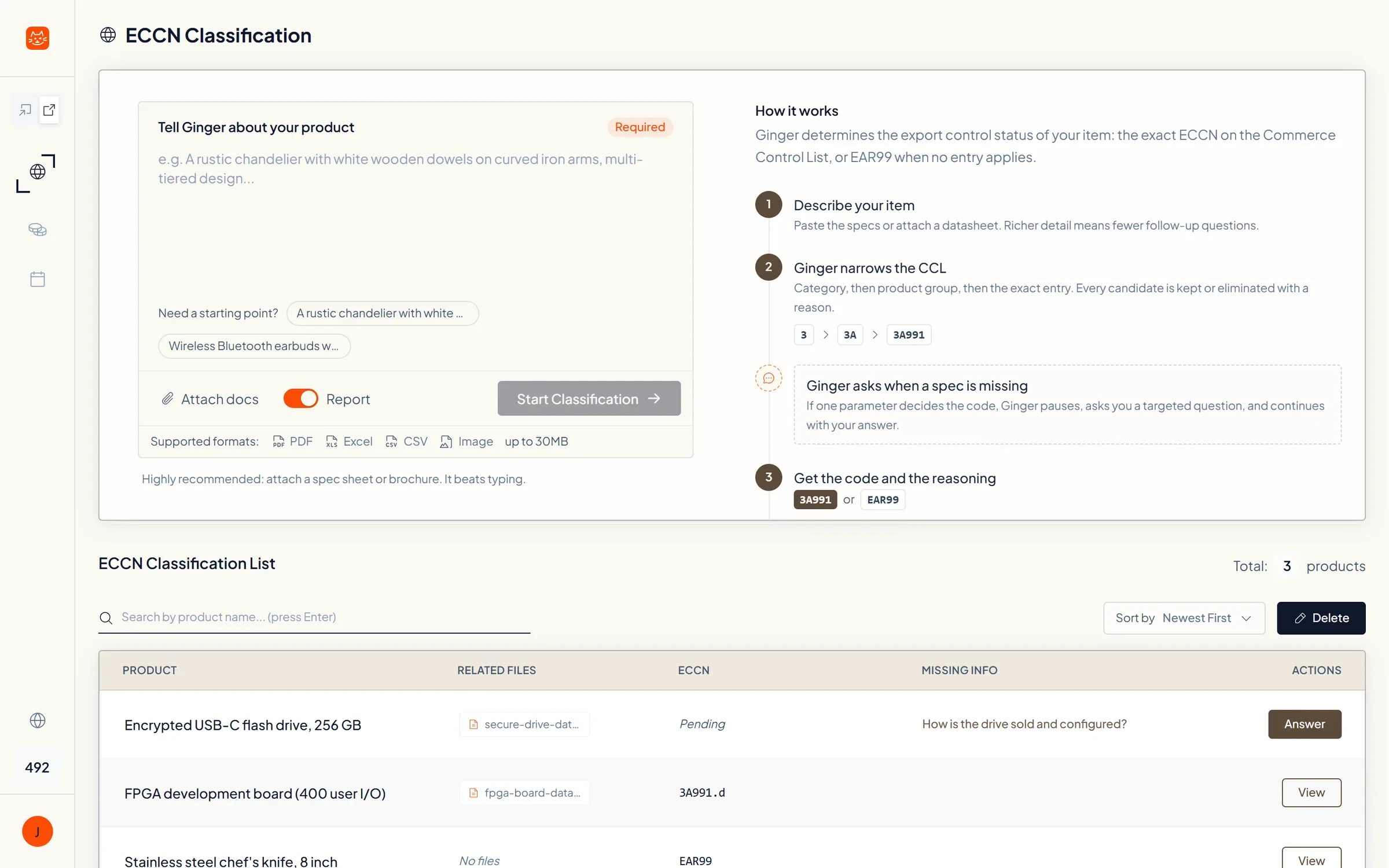
Enter a product description with technical specifications, upload a spec sheet, or provide a datasheet. The more technical detail you provide, the more precise the control parameter analysis.

02

AI Analyzes Every Control Parameter

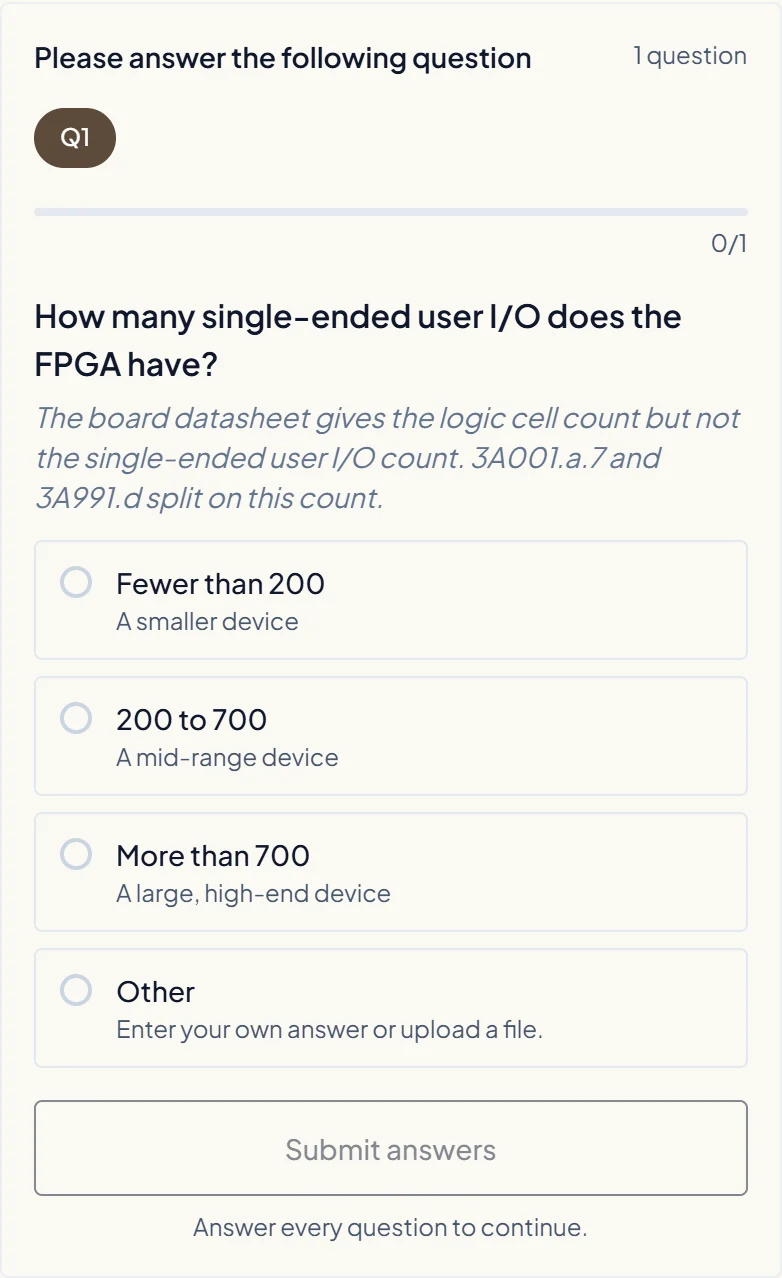
The AI follows the DDTC/BIS prescribed order of review: USML first, then CCL. For each candidate ECCN, it checks every control parameter against your product's specifications. When a product description is insufficient to determine whether a specific control threshold is triggered, the AI asks targeted clarifying questions, just like our HTS Classification Researcher.

03

Receive Your Research Report

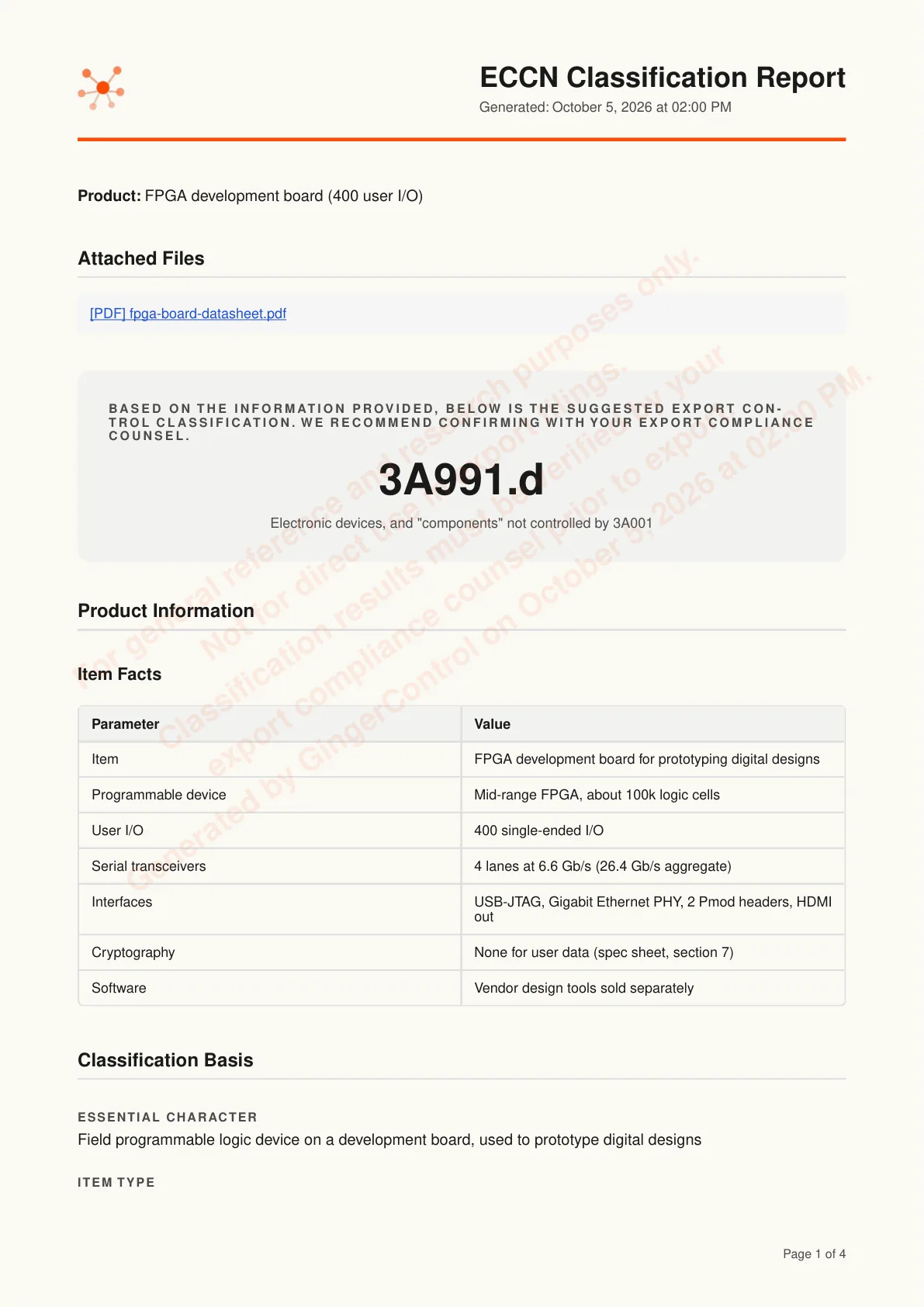
Get a detailed research report listing all candidate classifications with inclusion and exclusion reasoning for each. The report includes the full reasoning chain showing how each control parameter was evaluated, ready for your export compliance team or counsel to review.

Key Features

DDTC/BIS Order of Review

The AI follows the regulatory prescribed sequence: screen against ITAR (USML) first to determine jurisdiction, then proceed to EAR (CCL) classification. This is the same order of review that compliance officers and the government use.

Deep Control Parameter Analysis

Unlike tools that ask 'what category is your product?', our AI reads your technical specifications and checks every control parameter within each candidate ECCN. It determines whether your product meets specific thresholds for performance, capacity, accuracy, or other controlled characteristics.

Conversational Clarification

When a product description does not contain enough detail to evaluate a control parameter, the AI asks targeted questions. If a product might be controlled based on an undisclosed specification, we ask rather than assume, preventing both over-classification and dangerous under-classification.

Complete Candidate Reasoning

Every research report lists all candidate ECCNs considered, with detailed inclusion and exclusion reasoning for each. See exactly why a candidate was included or ruled out, which control parameters were triggered, and how the final determination was reached.

API Access for All Tools

Every tool in the export control suite is available via API. Integrate ITAR screening, ECCN classification, end-use screening, license determination, and exception analysis directly into your compliance workflows, ERP, or trade management systems.

Batch Processing

Upload spreadsheets with hundreds of products and process them in parallel. Get a research report for each product with full reasoning chains, ready for bulk compliance review.

How GingerControl Compares

GingerControl is the only export control tool that combines deep control parameter analysis, conversational clarification, and complete candidate reasoning in a single workflow.

Export control tool comparison: GingerControl vs KYG Trade, BITE Data, and ECCN.help
CapabilityGingerControlKYG TradeBITE DataECCN.help
ITAR vs EAR Jurisdiction (DDTC/BIS order of review)PartialBasic
ECCN Classification (all 10 CCL categories)BasicLow accuracy
Deep Control Parameter Analysis (checks every control threshold)
Conversational Clarification (asks when product info is insufficient)
'Specially Designed' Analysis (EAR Part 772)
Complete Candidate Reasoning (inclusion/exclusion logic for every ECCN)
Audit-Ready Research Report (full reasoning chain)Partial
End Use / End User ScreeningPartial
Export License Requirements (Commerce Country Chart)Limited
License Exception Eligibility (TMP, STA, ENC, GOV)
API Access
Batch Processing
End-to-End Workflow (ITAR → ECCN → Screening → License → Exception)PartialPartial

Frequently Asked Questions

How does GingerControl determine ITAR vs EAR jurisdiction?

+

GingerControl follows the DDTC/BIS prescribed order of review. The AI first screens your product against all 21 categories of the U.S. Munitions List (USML) to determine whether it falls under ITAR jurisdiction. If the product is not ITAR-controlled, the AI proceeds to classify it under the Commerce Control List (CCL) per EAR. This is the same regulatory sequence that compliance officers, the Directorate of Defense Trade Controls, and the Bureau of Industry and Security follow.

What makes GingerControl's ECCN classification different from other tools?

+

Most export classification tools either ask users to self-identify their ECCN category or match product descriptions against ECCN text at a surface level. GingerControl reads your product's technical specifications and checks every control parameter within each candidate ECCN, determining whether your product meets specific thresholds for performance, capacity, frequency, accuracy, or other controlled characteristics. When a product description lacks detail needed to evaluate a specific control parameter, the AI asks targeted clarifying questions rather than guessing. Every research report includes the complete inclusion and exclusion reasoning for each candidate ECCN.

Can GingerControl handle the full export compliance workflow?

+

Yes. GingerControl covers the entire export control lifecycle: ITAR jurisdiction screening against all 21 USML categories, ECCN classification across all 10 CCL categories with 'specially designed' analysis, end-use and end-user screening against OFAC SDN and BIS lists, export license requirement determination using the Commerce Country Chart, and license exception eligibility analysis for TMP, STA, ENC, GOV, and other exceptions. Each step produces a detailed research report with full reasoning.

Does GingerControl provide audit-ready documentation?

+

Every research report includes the full reasoning chain: which USML categories and ECCNs were evaluated, which control parameters were checked, why candidates were included or excluded, and the legal basis for the determination. Reports can be exported and attached to your compliance records, shared with export counsel, or submitted as supporting documentation during audits or voluntary self-disclosures.

Is the export control suite available via API?

+

Yes. Every tool in the export control suite, ITAR screening, ECCN classification, end-use screening, license determination, and exception analysis, is available via API. You can integrate directly into your ERP, trade management system, or internal compliance workflows. Batch endpoints support processing hundreds of products in a single call.

Start Your Export Control Research

Screen your products against ITAR and classify under the Commerce Control List with full reasoning chains. Available via API or talk to us about integration.

For general reference only. See compliance disclaimer.

Compliance Reminder

This is an HTS classification researcher. Results are for general reference, educational, and planning purposes only, designed to enable better communication between trade compliance teams, importers, and licensed customs brokers. Per CBP Ruling HQ H290535, providing HTS classifications beyond 6 digits for specific imports constitutes "customs business" under 19 U.S.C. § 1641. Do not use these results directly in customs entry documents without independent review by a licensed customs broker.

Read full compliance disclaimer

We use cookies to understand how visitors interact with our site. No personal data is shared with advertisers.