Per research run
3~5 min
92~98% time saved
Product to full GRI reasoning report
For never-classified products, composite goods, and any SKU where the heading isn’t obvious.
Product
GRI legal reasoning, end to end. From a one-line product description to a research report with full GRI 3(b) and Carborundum essential-character analysis, ready for your licensed customs broker to confirm.
Ginger follows the same GRI logic customs uses, tested across electronics, chemicals, automotive parts, machinery, medical devices, and consumer goods.
Pro Tip
Got spec sheets or product docs? Upload them. Brokers always ask, and so does Ginger. More context, more precise research.
Per research run
3~5 min
92~98% time saved
Product to full GRI reasoning report
For never-classified products, composite goods, and any SKU where the heading isn’t obvious.
What it replaces
1 to 2.5 hrs
Of customs-broker desk time per SKU
Cross-referencing spec sheets, end use, CROSS rulings, and chapter and section notes, then drafting a GRI memo. One research run covers both.
Open the Researcher
Or chat with chen@gingercontrol.com
Manual classification time reflects typical desk effort for borderline and composite classifications, the cases the HTS Researcher is built for.
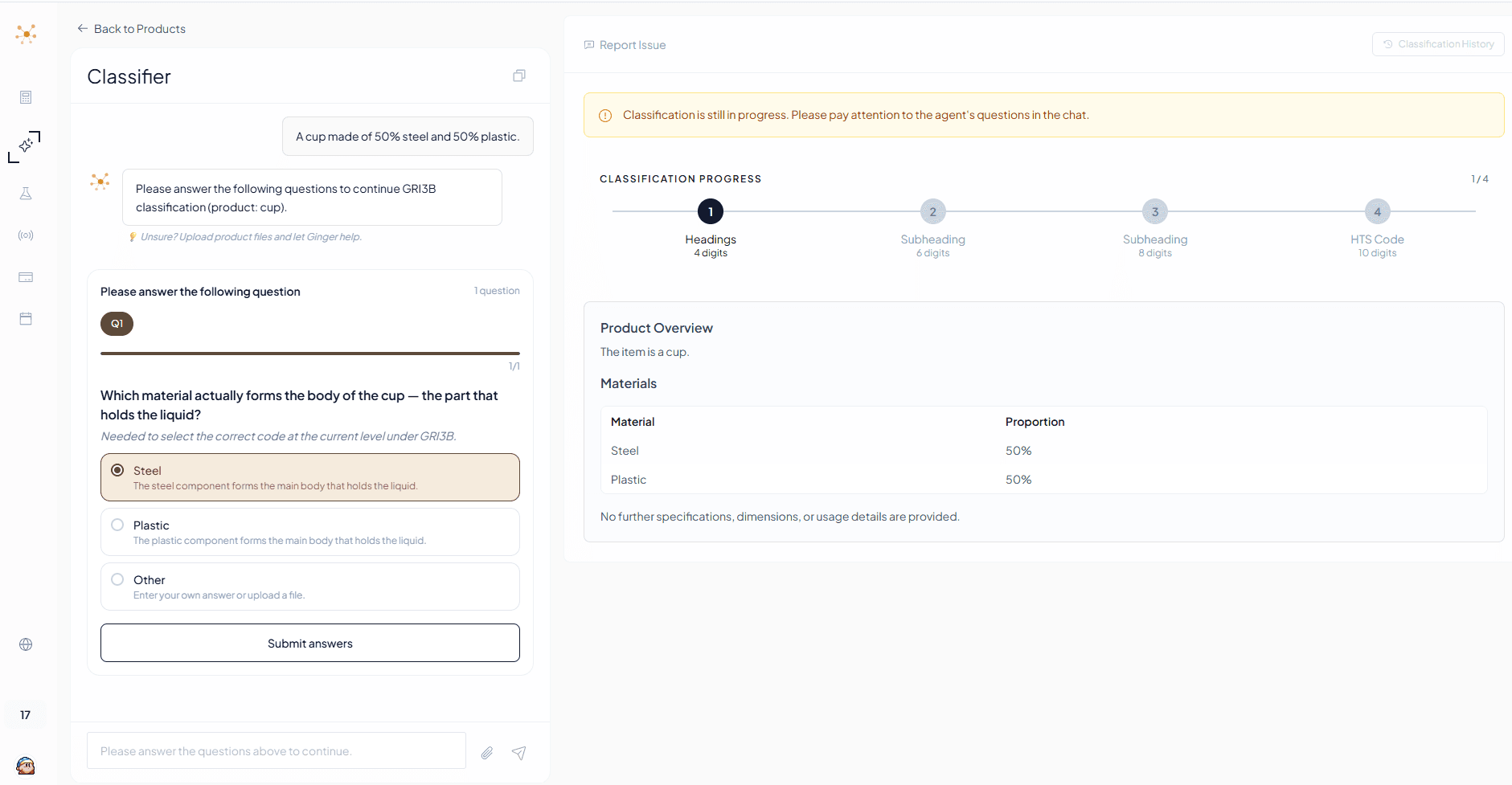
01 / Clarifying Questions
When a product could fall under multiple headings, the tool asks before it answers: ultimate use, purchaser expectations, advertising and packaging. The Carborundum factors drive the questions, not text similarity.
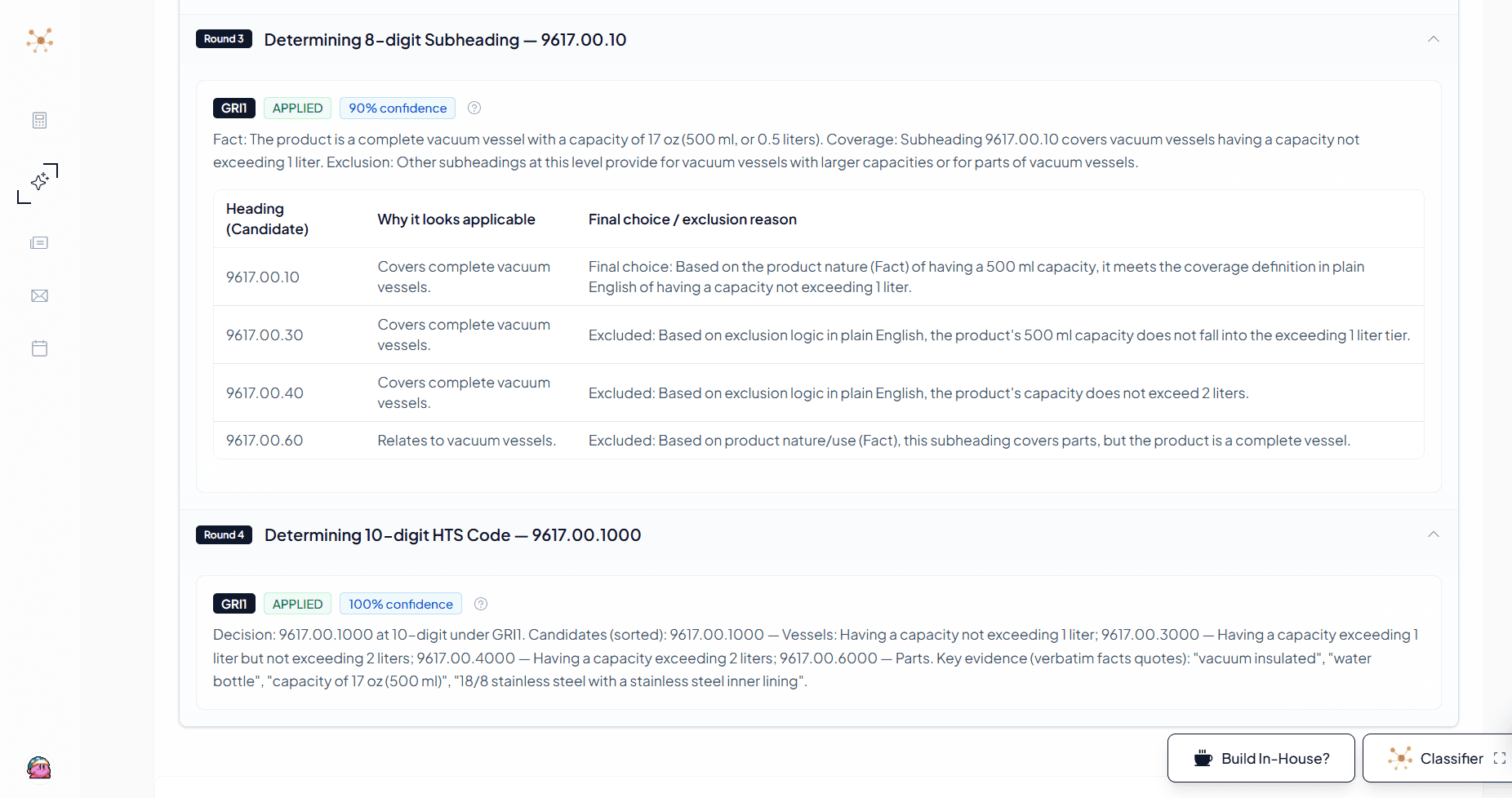
02 / GRI Reasoning Chain
Every result walks the General Rules of Interpretation step by step: which headings were considered, why alternatives were excluded, and the legal basis for the recommended code.
03 / Audit-Ready Report
Every result exports as a PDF with product details, reasoning chain, conversation log, and legal references, ready for your licensed customs broker’s review.
Composite goods? GingerControl runs the full GRI 3(b) playbook.
Text-matching tools stop at the most familiar heading. We start where licensed brokers do, by detecting when a product triggers essential character analysis, then asking the six questions a broker would ask.
Composite product
A device that plays music, functions as a smart hub, and has a display screen.
Multi-function detector
When GRI 1 through 3(a) cannot decide, essential character analysis is required. Our engine catches this trigger automatically.
Six-factor essential character analysis
Each factor is a directional vote. The synthesis points to one component as the product’s essential character.
Physical characteristics
Which component dominates form, materials, and construction?
Ultimate use
What is the product primarily used for in daily operation?
Purchaser expectations
What does a typical buyer expect to use it for?
Channels of trade
Where is it sold? Which retail category does it belong to?
Advertising and packaging
How is it marketed? What headlines the box and the ads?
Economic practicality
What is the BOM cost ratio across components?
Essential character
Six factors synthesized into one verdict, with the reasoning chain preserved for your customs broker to review.
Output
Same hardware, three possible HTS headings
Audio-led
HTS 8518
Speakers and audio reproducers
Display-led
HTS 8528
Monitors and projectors
Hub-led
HTS 8517
Communications and networking apparatus
Same hardware. Three headings. Three duty rates. This is the call text-matching tools cannot make.
Rulings Before the Code, Not After
CBP’s CROSS database records how comparable products were actually classified. The difference between research and rationalization is when a tool reads it.
Citing rulings after choosing a code is confirmation. Reading them before choosing is research. The order is the entire difference.
Enter a product description, answer Ginger’s questions, and hand your broker the research with full GRI reasoning attached. No signup required.
For general reference only. See compliance disclaimer.
Compliance Reminder
This is an HTS classification researcher. Results are for general reference, educational, and planning purposes only, designed to enable better communication between trade compliance teams, importers, and licensed customs brokers. Per CBP Ruling HQ H290535, providing HTS classifications beyond 6 digits for specific imports constitutes "customs business" under 19 U.S.C. § 1641. Do not use these results directly in customs entry documents without independent review by a licensed customs broker.
Read full compliance disclaimer →We use cookies to understand how visitors interact with our site. No personal data is shared with advertisers.